
Your team has done the work. You’ve generated a pile of ideas, some practical, some weird, a few that feel electric. Then the meeting happens.
Someone senior frowns. Someone confident talks faster. Someone else starts defending their favorite concept like it’s a family member. Ten minutes later, you have a winner, often the safest idea that survived the room’s politics.
Psychologists have a name for this phenomenon. Groupthink occurs when people become so focused on agreeing with one another that they stop thinking clearly. It’s a real phenomenon, and it shows up in workplaces that are smart, busy, and under pressure. I’ve watched this play out in boardrooms, creative reviews, and product meetings, even at Walt Disney Company, where I was the former vice president of innovation and creativity.
When the selection process is fuzzy, we reach for shortcuts, whether hierarchy, volume, or vibes. The “Highest Paid Person’s Opinion,” which is as common as it is expensive.
So let’s make idea selection less subjective, without sucking the energy out of it.
5 STEPS TO APPLY THE STARGAZER TOOL
The tool I use is called Stargazer. I borrowed it from Richard Branson of Virgin, then adapted it for teams that need a clean way to compare ideas against what success actually means.
1. DEFINE SUCCESS BEFORE YOU FALL IN LOVE
Most teams do this backward. They hold brainstorming sessions, pick a few favorites, then scramble to justify them with criteria they invent after the fact.
Flip it. Before evaluating a single concept, define what “good” looks like for this project. Choose five success criteria that matter for the decision you’re making right now. Keep them specific and measurable enough that you can argue about them productively.
Here are five example criteria:
- Brand fit: Does the idea align with the organization’s values?
- Customer truth: Is this idea embedded in consumer insight?
- Speed to market: Can you deliver a first version within an agreed-upon timeline?
- Financial impact: Is there a believable path to the numbers you need?
- Social energy: Would people talk about it, share it, rally around it?
Other criteria may also apply, such as whether the idea can be executed within the allowed time frame and budget, or whether it has the potential to meet or exceed revenue projections. The criteria will differ for each challenge, which is why early definition is so important.
2. DRAW YOUR STARFISH
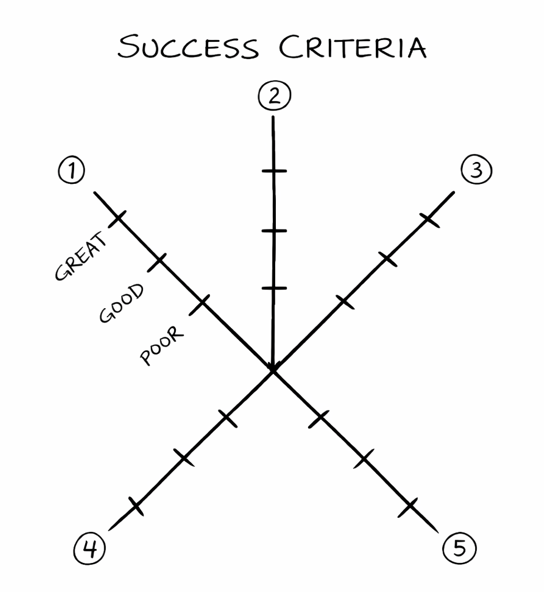
The Stargazer method, when illustrated, looks like a starfish. Draw a circle in the middle, then five arms reaching out. Label each arm with one of your criteria.
At the end of each arm, mark three levels:
- Poor
- Good
- Outstanding
Each arm represents a success criterion, and the three notches allow you to quickly score how well an idea performs against it. The closer the mark is to the outer edge, the better the idea meets that particular criterion.
That’s it. You’ve built a decision compass that makes your strategy visible.
Use the same criteria for every idea in this round. If you change the rules midstream, you’re back to politics. Second, make the criteria project-specific, as described in step one.
To discover the remaining steps, read the entire article over on Fast Company.